██████╗ ██╗██╗  ██╗███████╗██╗
██╔══██╗██║╚██╗██╔╝██╔════╝██║
██████╔╝██║ ╚███╔╝ █████╗  ██║
██╔═══╝ ██║ ██╔██╗ ██╔══╝  ██║
██║     ██║██╔╝ ██╗███████╗███████╗
╚═╝     ╚═╝╚═╝  ╚═╝╚══════╝╚══════╝
███████╗████████╗██████╗ ███████╗███████╗████████╗
██╔════╝╚══██╔══╝██╔══██╗██╔════╝██╔════╝╚══██╔══╝
███████╗   ██║   ██████╔╝█████╗  █████╗     ██║
╚════██║   ██║   ██╔══██╗██╔══╝  ██╔══╝     ██║
███████║   ██║   ██║  ██║███████╗███████╗   ██║
╚══════╝   ╚═╝   ╚═╝  ╚═╝╚══════╝╚══════╝   ╚═╝
# Plain-text mirror. Same words as the human page, minus everything a browser needed.
Shopify is a subscription with a published price. Adobe Commerce is a sales conversation with a quote attached to your revenue. Magento Open Source is free software that bills you in engineering time instead of licence fees, and Adobe now keeps it at arm’s length. For a small or mid-sized Indian brand without an in-house development team, Shopify is the honest default, and the real money leaks through payment fees rather than the plan price. If you have a large catalogue, complicated B2B pricing rules, or a team that already runs PHP infrastructure, ask Adobe for a quote and compare it against three years of your own developer time. Everything below is the detail behind that.
Most people who write to me about Magento are asking about a product that has not been sold under that name since April 2021.
I run Pixel Street, a web design studio in Salt Lake, Kolkata. We design and build for brands like Coca-Cola, ITC and Marico, so platform arguments land in my inbox most weeks. Almost every comparison of these two is written as a scorecard: thirteen rounds, a winner announced in each one, a champion crowned at the end. That format measures the wrong things, and it is how a wrong number survives for years without anybody checking it.
So start with the number. You will read in a great many places that Magento Commerce “starts at around $22,000/year for smaller businesses”. That figure cannot be traced to Adobe. Nobody can trace it, because Adobe does not publish a price at all. Further down I show exactly where it came from.
Shopify is a subscription with a published price. Adobe Commerce is a sales conversation with a quote attached to your revenue. Magento Open Source is free software that bills you in engineering time instead of licence fees, and Adobe now keeps it at arm’s length. For a small or mid-sized Indian brand without an in-house development team, Shopify is the honest default, and the real money leaks through payment fees rather than the plan price. If you have a large catalogue, complicated B2B pricing rules, or a team that already runs PHP infrastructure, ask Adobe for a quote and compare it against three years of your own developer time. Everything below is the detail behind that.
Adobe acquired Magento in 2018. In April 2021 it folded the paid product into its own brand, and Magento Commerce became Adobe Commerce. The free edition kept the old name. Adobe still writes “Magento Open Source” in its current documentation, and still treats it as a separate code base from the paid product.
So “Shopify vs Magento” is really three products in a trench coat:
The rename is not trivia. It changed who the product is sold to. Adobe sells to enterprises with procurement departments, and the platform’s footprint reflects that. In the W3Techs survey dated 30 July 2026, Shopify was running 5.3% of all websites and Adobe Commerce 0.3%. Among sites where the content management system is known, that is 7.6% against 0.4%. W3Techs has even relabelled its entry from Magento to Adobe Commerce.
None of that makes Adobe Commerce a bad platform. It makes it a platform for a specific kind of company, and most of the businesses asking me the question are not that company.
[IMG: Shopify is hosted, priced in public and runnable by a non-technical person. Adobe Commerce is licensed with no published price, quoted against your gross merchandise value and sold to enterprises with procurement departments. Magento Open Source charges no licence fee but assumes a developer is available.]
Adobe does not publish a price for Adobe Commerce. There is no plan grid, no per-month tier to link to. The licence is quoted per customer and the quote is built around your gross merchandise value.
The $22,000 comes from agency blogs. The most linked of them is a Magento development agency’s pricing explainer, updated 8 July 2026, which prints a ladder: $22,000 a year under $1M GMV, $32,000 to $5M, $49,000 to $10M, $75,000 to $25M, $125,000 above that. Read the small print on that same page and it says the figures are “given purely for illustrative purposes and does not indicate the exact figures of the vendor”. It is one agency’s illustration of a budget conversation. It was never an Adobe price, and it travelled from blog to blog until it turned up in comparison articles wearing a tie.
I am not replacing it with a better guess. Here is the rule I use instead, and I would apply it to any enterprise software: if the vendor does not publish a price, the number is not the number. Get the quote, then add the parts the quote never covers. On the Adobe side that means hosting or cloud fees, the implementation build, extensions, and a retainer for upgrades, because a platform that ships versioned releases needs someone to install them.
The comparison people should be running is not licence against licence. It is three years of Shopify plus fees against three years of Adobe licence plus hosting plus a development team. That second column is where the real spend sits, and it is the column agencies like mine are usually being hired to fill. I would rather say that plainly than sell you a platform on a number nobody can source.
Shopify publishes its plans, which already puts it ahead on honesty. These are the figures on Shopify’s India pricing page as of 30 July 2026.
| Plan | Billed monthly | Billed yearly | Fee on non-Shopify payment providers |
|---|---|---|---|
| Basic | ₹1,994/month | ₹1,499/month | 2% |
| Grow | ₹7,447/month | ₹5,599/month | 1% |
| Advanced | ₹30,164/month | ₹22,680/month | 0.6% |
| Plus | from ₹1,75,000/month | quoted per customer | 0.2% |
There is a three-day free trial and an introductory rate of ₹20 a month for the first three months, and Shopify POS Pro is ₹7,000 a month per location on top.
Now the part that matters here and gets skipped in most comparisons written for a US audience. That last column is the fee Shopify charges when you use a payment provider other than Shopify Payments. Shopify Payments is available in a fixed list of countries and regions, and India is not one of them. An Indian merchant is in that last column permanently.
Stack the arithmetic. On Basic, Shopify takes 2% of every order for using an outside gateway. Razorpay charges 2% on domestic cards, UPI and netbanking, plus 18% GST on that fee, and up to 3% on international cards. On a month of ₹10,00,000 in sales that is roughly ₹20,000 to Shopify, ₹20,000 to the gateway and ₹3,600 of GST on the gateway fee. About ₹43,600 in transaction costs against a plan fee of ₹1,499. The subscription was never the expensive part.
[IMG: On a month of ₹10,00,000 in sales, the Shopify Basic plan fee of ₹1,499 is a sliver beside about ₹43,600 of transaction costs: ₹20,000 to Shopify at 2%, ₹20,000 to the gateway at 2%, and ₹3,600 of GST on the gateway fee.]
That single fact reorders the decision. Moving from Basic to Advanced costs about ₹21,000 more a month on annual billing and cuts the Shopify fee from 2% to 0.6%. At ₹10,00,000 of monthly sales that saves ₹14,000, so it is not worth it. At ₹25,00,000 it saves ₹35,000, so it is. Work out your own crossing point before you pick a plan, because Shopify will not do it for you on the pricing page.
Magento Open Source charges no platform fee on transactions at all. Your gateway still charges you, but nobody takes a second cut for the privilege of processing a sale. On high volume that is real money, and it is the strongest financial argument the open-source side has.
[IMG: Shopify Pricing]
An older capture of Shopify’s pricing page, kept here for the record. The plan names and figures in the table above are what the same page shows today. Source: www.shopify.com
The free edition is alive, and it is more current than its reputation suggests. Version 2.4.9 shipped on 12 May 2026 with official support for PHP 8.5 and Symfony 7.4 LTS. If you last looked at Magento during the 1.x death march, that is a different piece of software.
What has changed is the support position, and this is the part to read carefully before you commit a five-year store to it. Adobe’s published support dates run in three-year windows from each release:
Adobe offers an extra year of support at no cost on 2.4.6 and 2.4.7, and then states the limit in its own release policy: “Extended support security patches are available to Adobe Commerce customers only. They are not available for the Magento Open Source code base.”
Read that sentence twice if you are running the free edition. The safety net is a paid feature. When your version falls out of the window, patching is your problem, and an unpatched store that takes card payments is not a cost saving. If you go this way, budget a retainer for upgrades and read our guide to vulnerability assessment and penetration testing before you launch, not after.
There is also a community answer to all this. Mage-OS is a community-owned distribution built on the Magento Open Source 2.4.9 code base, run by an association with an elected board and explicitly not affiliated with Adobe. Its 3.2.0 release on 14 July 2026 carried the current Magento security patch. If you want the open-source path with a maintenance community rather than a vendor, that is where the people went.
Shopify is built so a non-technical person can add products, run orders and change a homepage banner without opening a ticket. Magento assumes a developer is available. That is not a knock on Magento, it is its design intent, and it is the single question that decides most of these projects. If the answer to “who updates this on Monday morning” is “our marketing executive”, the decision is already made.
[IMG: Shopify User-friendly Interface]
Source: www.shopify.com
Shopify themes are quick and constrained. You get a good store fast, and past a point you are writing Liquid and working around the platform’s assumptions. Magento gives you the whole front end, and Adobe Commerce as a Cloud Service goes further by being headless, which means the storefront is yours to build in whatever framework you like.
The honest version of this trade-off: freedom is only worth what you can afford to use. A studio that will spend real time on the front end can make either platform look distinctive. A brand that wants a theme installed by Friday should buy the constrained one and spend the saved budget on photography.
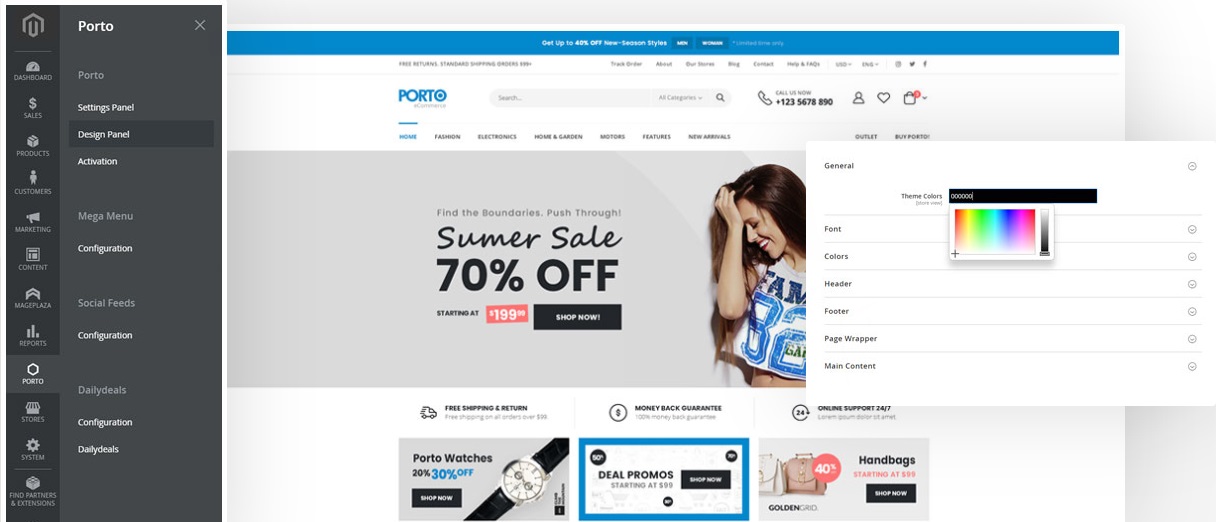
[IMG: The Porto theme’s own configuration panel inside the Magento admin: a Porto item in the left admin rail opens Settings Panel, Design Panel and Activation screens, with further Mega Menu and Social Feeds configuration below, and the themed storefront previewed behind it.]
Source: www.cloudways.com
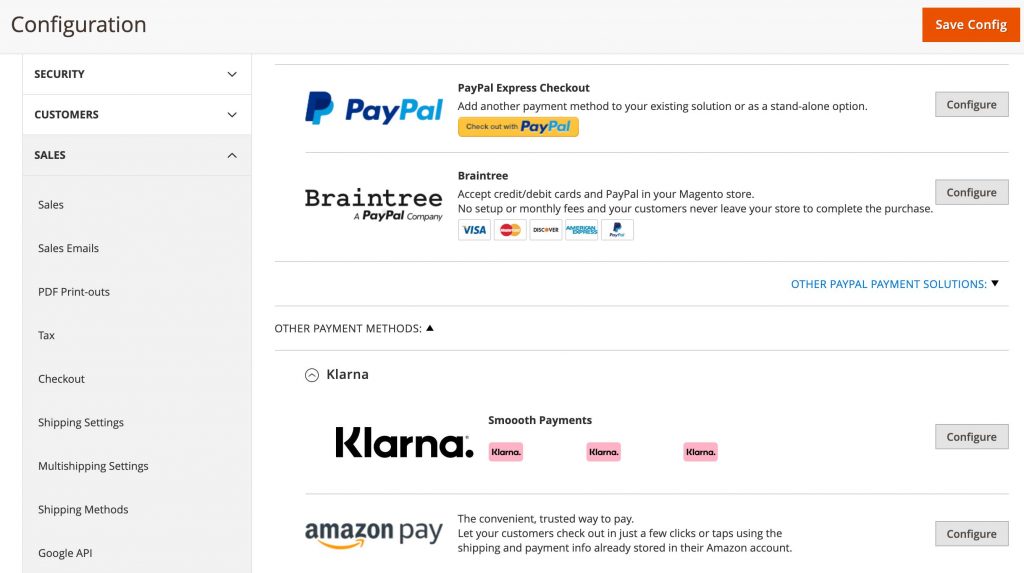
Both platforms connect to the gateways an Indian store needs. The difference is the platform fee described above: Shopify takes its cut on top of the gateway unless you are in a Shopify Payments country, and Magento takes nothing. Checkout control follows the same pattern. Shopify’s checkout is Shopify’s, which is good for conversion and bad for anyone who needs an unusual flow. Magento’s checkout is code, so it can be anything you can pay a developer to build.
[IMG: Payment Gateways of Magento]
Source: www.magic42.co.uk
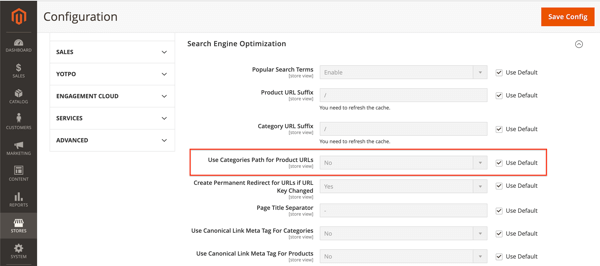
Comparisons of these two traditionally hand SEO to Magento, because it allows deeper URL and template control. That is still true, and it matters much less than it used to. Both platforms produce crawlable, editable pages. What decides visibility now is whether your product and category pages say something a machine can attribute to you: real specifications, real answers, real inventory data, rather than the manufacturer’s description that forty other retailers also pasted in.
Shopify’s constraints cost you a few structural options. Magento’s freedom costs you a developer every time you want a template changed. Neither of those is why a store ranks. If you want the platform-agnostic version of that argument, we wrote it up in our comparison of the major CMS platforms.
[IMG: SEO Friendly- Magento]
Source: www.contentkingapp.com/
Shopify runs the servers, ships the patches and answers the pager. Adobe Commerce as a Cloud Service does the same for paying customers, with automatic updates and a stated 99.9% availability. Self-hosted Magento performs exactly as well as the hosting and the team you put behind it, which in practice means it is fast when someone is being paid to keep it fast and slow when that person leaves.
This is the least glamorous line in the comparison and the one that has ended the most projects I have seen.
[IMG: Shopify Site Performance]
Source: cdn.shopify.com
Both ecosystems are large enough that “does an app exist” is rarely the deciding question. Shopify’s apps install in a click and bill monthly, so a store running fifteen of them has a second subscription bill worth auditing. Magento extensions are code you install and then own the consequences of, including at upgrade time.
If you meet a comparison that recommends Oberlo for dropshipping, check its date. Shopify sunset Oberlo, and its staff announced in May 2022 that the last day of access would be 15 June 2022, with DSers as the migration partner. The dropshipping category on Shopify is now served by third-party apps rather than a Shopify-owned one. It is a small thing, and it is the kind of small thing that tells you how old a comparison article is.
[IMG: Shopify Drop shipping]
Source: shopify.com/in/dropshipping
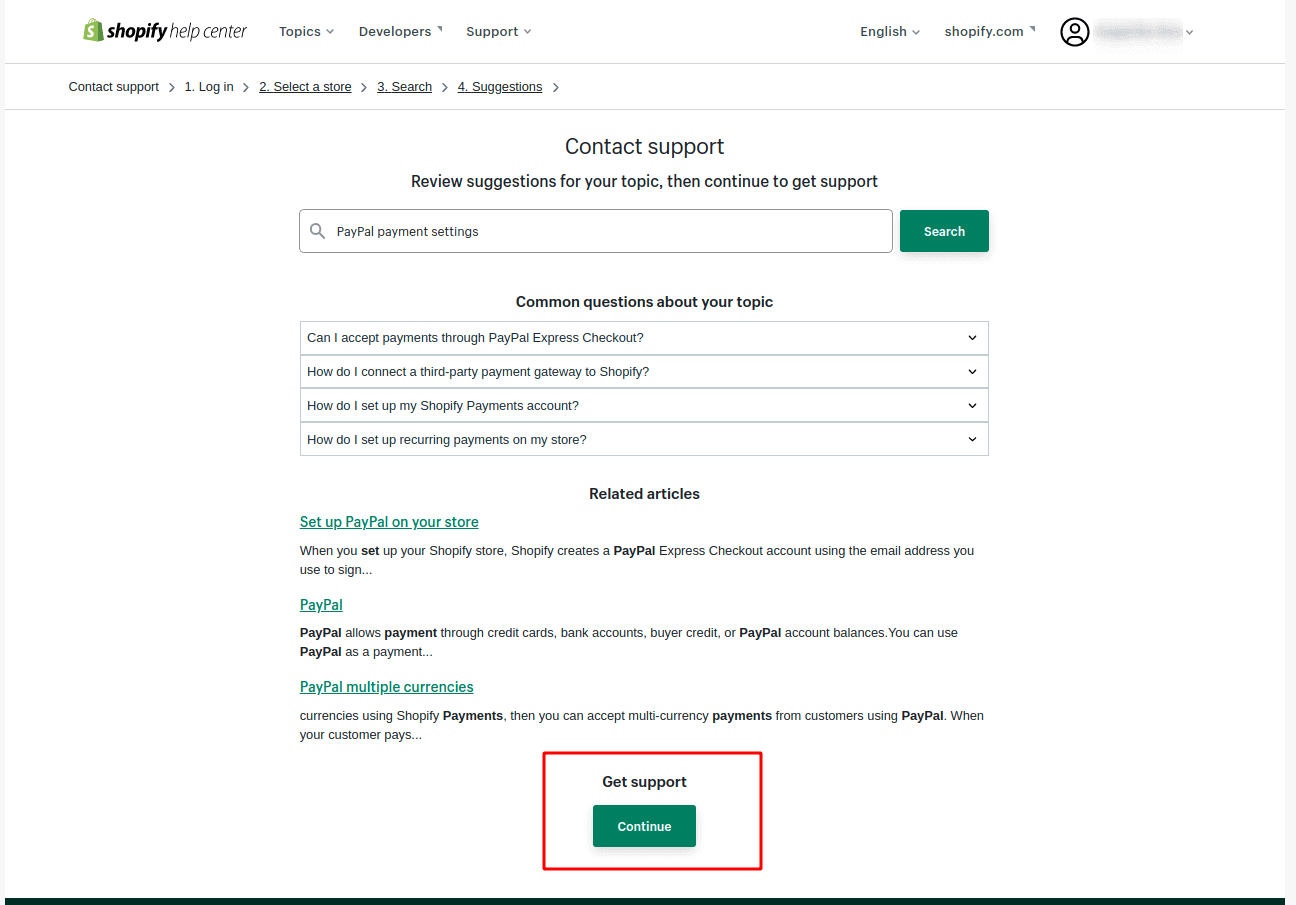
Shopify support comes with the subscription on every plan. Adobe support comes with the licence. Magento Open Source comes with a forum, a Slack channel and whoever you have retained. Free software has never meant free help, and the businesses that get burned here are the ones that budgeted for the licence and not for the person.
[IMG: Shopify Help Center]
Source: www.identixweb.com
Vendor comparison pages exist to be won by the vendor who published them. Shopify’s own page comparing itself to Magento is a sales asset, and Adobe’s equivalent is too. Use them to find out what a platform thinks is important, not to settle the question.
[IMG: Key Features- Shopify vs Magento]
Source: www.shopify.com
Both directions are possible and neither is cheap. Products, customers, orders and URLs can be moved with migration tools. What does not move is the front end, the integrations, the app-specific data and the search rankings attached to your old URL structure. Plan a redirect map before anything else, because that is the part people forget and then spend six months recovering from.
I have written before about rented land. I lost two companies before Pixel Street, and the lesson that survived both failures is simple: never build your main asset on ground someone else controls. A hosted store is a lease. That is a perfectly rational thing to sign when the alternative costs more than it returns, but sign it knowing what it is. Keep your product data, your customer list and your content exportable, and the lease stays a choice rather than a trap.
| Shopify | Adobe Commerce | Magento Open Source |
|---|---|---|
| No in-house developers, and the store must be run by the marketing team | Enterprise catalogue, complex B2B rules, or multi-brand and multi-region operations | You already employ PHP developers and intend to keep employing them |
| You want a published price you can plan a budget against | Procurement can handle a quoted licence and a build project | Transaction volume high enough that a platform fee hurts more than a salary |
| Launch date matters more than structural flexibility | You need Adobe’s wider stack, or SaaS operations with an availability commitment | You want to own the code and accept owning the patching |
| Uptime and PCI compliance should be somebody else’s job | The store is large enough that platform downtime has a rupee value per hour | You are comfortable tracking Adobe’s support windows, or moving to a community distribution |
If you are weighing the open-source route more broadly, the closer fight is not this one. It is Shopify against WooCommerce, which is the comparison most Indian small businesses are actually running, and the prices in that post come from the same Shopify pricing page as the table above.
Magento Open Source is free to download and run. Adobe Commerce is not, and Adobe does not publish its price. Free also excludes hosting, the build, extensions and the person who applies security patches, which is why “free” and “cheap” are different words.
No. Version 2.4.9 shipped in May 2026 and the community distribution Mage-OS shipped 3.2.0 in July 2026. What is true is that it is a much smaller slice of the web than Shopify, that Adobe’s attention is on the paid product, and that extended security patches are reserved for Adobe Commerce customers.
Whatever Adobe quotes you. The ladders you find online, the $22,000 figure among them, come from agencies illustrating a budget conversation, and at least one of them says so in its own small print. Ask for the quote, then price the hosting, build and upgrade retainer separately.
Yes, and you have no other option, because India is not on the list of countries where Shopify Payments is offered. Budget for the platform fee on your plan on top of your gateway’s charges, and choose your plan by working out where the fee saving overtakes the higher subscription.
Check your version against Adobe’s support dates first. If you are on 2.4.6 you are out of regular support in August 2026. After that the choice is an upgrade project, a move to a community distribution, or a replatform, and the deciding factor is usually whether you have a developer to hand, not which platform is better. Budgeting help is in our breakdown of what web design actually costs in Kolkata.
Pick the platform that matches the team you actually have, not the team you plan to hire. Then spend the argument you saved on the things that move revenue: photography, product copy that says something specific, a checkout you have watched real customers use.
Our eCommerce team at Pixel Street works with both platforms, and the first thing we do on a platform call is ask who will run the store day to day. If you want that conversation, or a second opinion on a quote you have already been given, our eCommerce development services page has the details.
Every figure in this article traces to one of the following. Publisher and publication date are recorded so a claim can be checked against its origin, and re-checked when the origin changes.