██████╗ ██╗██╗  ██╗███████╗██╗
██╔══██╗██║╚██╗██╔╝██╔════╝██║
██████╔╝██║ ╚███╔╝ █████╗  ██║
██╔═══╝ ██║ ██╔██╗ ██╔══╝  ██║
██║     ██║██╔╝ ██╗███████╗███████╗
╚═╝     ╚═╝╚═╝  ╚═╝╚══════╝╚══════╝
███████╗████████╗██████╗ ███████╗███████╗████████╗
██╔════╝╚══██╔══╝██╔══██╗██╔════╝██╔════╝╚══██╔══╝
███████╗   ██║   ██████╔╝█████╗  █████╗     ██║
╚════██║   ██║   ██╔══██╗██╔══╝  ██╔══╝     ██║
███████║   ██║   ██║  ██║███████╗███████╗   ██║
╚══════╝   ╚═╝   ╚═╝  ╚═╝╚══════╝╚══════╝   ╚═╝
# Plain-text mirror. Same words as the human page, minus everything a browser needed.
White label is worth doing when you are buying capacity and someone to be accountable to, and it is a trap when you are buying a discount. Tell your client that a partner is involved, get copyright assigned in writing at both ends of the chain rather than assuming payment moved it, and settle who answers the phone during an outage before the first invoice instead of during the first outage. The rest of this page is the detail behind those three, and the two of them that people skip are the legal ones.
I am on the supply side of this arrangement. Agencies hire us to build things their clients believe were built in-house, and that is a normal and honest way to run a studio. Concealment is what makes it dishonest, and almost everything that goes wrong in white label work traces back to that one decision rather than to anything in the code.
The second thing worth saying before the guide starts is that this market has changed shape. What agencies used to send out was the cheap commodity build, and the cheap commodity build is the exact part of the industry that software has taken. A page selling white label as a way to get brochure sites made for less is describing 2019.
White label is worth doing when you are buying capacity and someone to be accountable to, and it is a trap when you are buying a discount. Tell your client that a partner is involved, get copyright assigned in writing at both ends of the chain rather than assuming payment moved it, and settle who answers the phone during an outage before the first invoice instead of during the first outage. The rest of this page is the detail behind those three, and the two of them that people skip are the legal ones.
[IMG: White Label WordPress Development]
You sell the work. Somebody else does it. The client sees your name on the invoice, your name in the emails, and your name on the handover call. The partner does design, build or maintenance and stays out of the frame.
That is the whole mechanism, and it is worth stating plainly because the usual description of it is written to make outsourcing sound like a strategy. It is not a strategy. It is a decision about where capacity comes from, and it succeeds or fails on the terms you set around it.
[IMG: White Label Business Model]
Source: khatabook-assets.s3.amazonaws.com
You scope the project with your client, agree a price, and brief the partner against a written specification. The partner builds and hands back. You review, you present, and you carry the relationship. The failure point in that sequence is the review step, because it is the one that gets skipped when the deadline is close, and it is the only thing standing between your client and work you have not read.
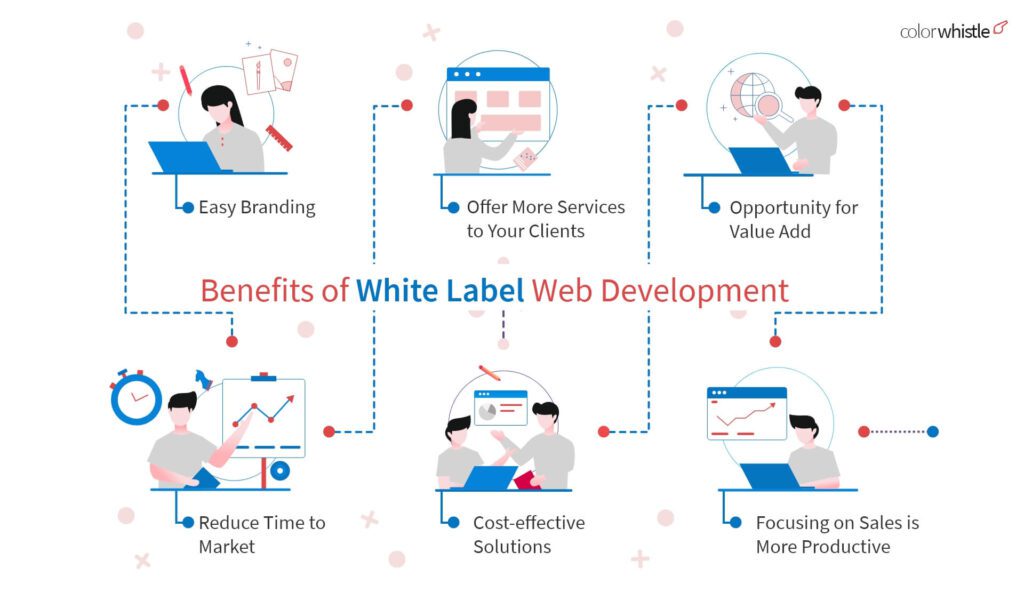
[IMG: Benefits of White Label Web Development]
Source: colorwhistle.com
You are buying capacity you do not have to keep. A studio's real constraint is that one person can only be in one conversation, and a partner lets you take a second project without hiring for a workload that may not survive the quarter. That is the honest benefit and it is a large one.
You are buying a skill you do not want to carry permanently. Nobody should hire a full-time developer for the one integration a year that needs one.
You are not buying a discount. Your margin is your price to the client minus the partner's price to you, and what is left has to cover the scoping, the review, the presentation and every support conversation for the life of the site. Agencies that treat the gap between the two numbers as profit discover the rest of the cost in month four. If cheapness is the reason for the arrangement, the arrangement will not survive the first project that goes wrong.
You are not buying absolution. The client signed with you. When something breaks, they call you, and "our partner is looking at it" is not an answer that anyone accepts twice.
This is the section that costs people money, and I have never seen it covered in a white label guide.
Paying for work does not move the copyright in it. Section 17 of the Copyright Act, 1957 starts from the position that the author of a work is the first owner of the copyright in it. There is a commissioned-work exception, and it covers "a photograph taken, or a painting or portrait drawn, or an engraving or a cinematograph film made, for valuable consideration". Website code and design files are not on that list. The other exception covers work made under a contract of service, which means an employee. A white label partner is not your employee.
So in the ordinary case the partner who wrote the code owns it, not you, and certainly not your client.
Fixing that takes a written assignment. Section 19 says an assignment is invalid unless it is in writing and signed by the assignor, and that it has to identify the work and specify the rights, the duration and the territory. Two defaults catch people who write a loose clause: if the assignment does not state a period, it is deemed to be five years, and if it does not state a territory, it is presumed to cover India only.
Now notice what that means in a white label chain, because the copyright has to travel two hops rather than one. Partner to you, and you to your client. Most arrangements do the second hop and forget the first, which leaves you promising your client something you do not hold. Get both in writing, and get a lawyer to draft them rather than adapting a template. I have set out the buyer's side of the same question, and the answers that should worry you, in the questions to ask before hiring a web design agency.
[IMG: Copyright has to travel from partner to agency to client, and the first hop is the one arrangements forget. Section 19 requires an assignment in writing, signed by the assignor, identifying the work and stating rights, duration and territory; with no period stated it is deemed five years, and with no territory stated it covers India only.]
Plenty of these arrangements run across a border, with the agency in one country and the studio in another. If yours does, and the studio is in India, the GST treatment is not the same as it would be on a domestic invoice, and I have never seen a white label guide say so.
Inside India it is ordinary. Web design and development is taxed at 18% GST under Heading 9983 of Notification No. 11/2017-Central Tax (Rate), and a registered agency buying from a registered partner claims it as input tax credit. The arithmetic and the SAC codes are in what web design actually costs in Kolkata.
Across a border it may be an export of services, which is a zero rated supply under section 16(1) of the IGST Act, 2017 (the Board's own explanation of zero rating is the clearest short statement of it). The word doing the work there is "may". Section 2(6) sets five conditions and they are cumulative: the supplier is in India, the recipient is outside India, the place of supply is outside India, payment reaches the supplier "in convertible foreign exchange or in Indian rupees wherever permitted by the Reserve Bank of India", and the two parties are not merely establishments of the same person.
That fourth condition is worth reading twice, because a great many write-ups state flatly that you must be paid in foreign currency. The statute does not say that. The rupee route is in the text, conditional on the RBI permitting it.
[IMG: Section 2(6) sets five cumulative conditions for an export of services: supplier in India, recipient outside India, place of supply outside India, payment in convertible foreign exchange or in rupees where the RBI permits, and the parties not establishments of the same person. All five means zero rated; one failure means 18% GST.]
If the supply does qualify, a Letter of Undertaking lets you invoice without charging integrated tax at all rather than charging it and waiting for a refund. If it does not qualify, you are back to 18% on an overseas client who was not expecting it. Which of the two you are in is a question for your chartered accountant and not for a blog, including mine. I am flagging that the question exists, because most white label pages price the work as though it does not.
[IMG: Risk of White Label Development]
The brief was thin and the build matched it. This is the most common failure by a distance, and it is yours rather than the partner's. A partner cannot infer a client's business from a page count. If you would not accept the brief from a client, do not pass it on.
Nobody read the work before the client did. Two people are now finding the same problem at the same time, and one of them is paying you.
The partner is busy in the week you need them. Capacity you do not own is capacity you are queueing for. Ask where you sit in the queue before you promise a date, not after.
The concealment leaks. A commit history, a support reply signed with the wrong name, a stray line in a footer. Clients rarely mind that you used a partner. They mind finding out on their own, and the trust cost lands on the relationship rather than on the build.
Nobody agreed who fixes it in year two. Maintenance is where the money and the resentment both live. Settle it in the first contract while everyone is still pleased with each other.
| What to settle | What it looks like when nobody did |
|---|---|
| Written assignment of copyright, partner to you and you to the client, with rights, duration and territory stated | You promised your client something you never held, and the default period is five years |
| Whether the partner may be named, and to whom | The client finds out from a commit log |
| Response times, and who is on the phone during an outage | You are the answering service for a fault you cannot fix |
| What happens to hosting, repository and domain access when either side walks away | The account nobody can log into is the one that matters |
| Maintenance scope and price for year two, agreed in year one | Every small fix becomes a negotiation |
| Non-solicitation, in both directions | Your partner has your client, or your client has your partner |
| Which GST treatment applies and who carries it if it is wrong | An unbudgeted 18% appears on an invoice a client already approved |
The standard list asks about experience, portfolio and turnaround. Those are worth asking and they are also the questions everybody prepares for. These are the ones that produce useful answers.
Ask the same things of yourself before you take white label work on. I have written about which services a studio should agree to sell at all in how to start a web design company, and refusing work you would have to conceal is most of that discipline.
[IMG: White Label WordPress Development Company]
This section used to rank the top five white label development agencies and put Pixel Street third among them. The list was dated 2023 and the ranking had no method behind it beyond our own preference, which is a polite way of saying it had none.
I have taken it out, as I have taken our self-ranking out of the other roundups on this blog. A list of agencies published on an agency's own website is an advertisement in a numbered format, and readers work that out faster than we would like. We do white label development, that fact belongs on a services page rather than dressed up as research, and you should judge it the same way you judge anyone else on this list of questions.
What replaces it is more useful in any case. A logo on a portfolio can mean a three-year retainer or one subcontracted afternoon, and nothing on the outside distinguishes them. The questions above work on any partner, including us. The client-side version of the same problem is set out in freelancer versus agency, and it is worth reading before you decide which side of this you are on.
The work that used to get white-labelled was the commodity build, and the commodity build is precisely what got cheap. Xiang Hui, Oren Reshef and Luofeng Zhou measured this on Upwork's own data through the release of ChatGPT, DALL-E 2 and Midjourney and published it in Organization Science in November 2024 (The Short-Term Effects of Generative Artificial Intelligence on Employment). Freelancers in the most exposed occupations lost work and lost earnings, and being good at the job did not protect anyone.
An agency reselling that layer at a markup is reselling a layer whose price is falling underneath it. That does not make white label pointless. It changes what is worth buying. Judgement, review, accountability and the ability to be held to a date are not what got cheap. Production hours are, and a partnership priced on production hours will be repriced by somebody's subscription. I have argued the full version of that case, including where the builders genuinely win, in AI website builders versus custom development.
The same logic applies to the platform choice underneath the work. A partner who only knows one stack will recommend it for everything, which is worth remembering when you read WordPress against a custom PHP build and find that the answer depends on the project rather than on the partner.
Legally that depends on your contract. Practically, yes, and I would tell them at the proposal stage rather than when something breaks. Almost no client objects to a partner. Most object to discovering one. You can disclose that a partner exists without naming them, and that is usually enough.
No. Section 17 of the Copyright Act makes the author the first owner and its commissioned-work exception does not cover code or design files, so ownership moves only by a written assignment under section 19. In a white label chain that has to happen twice, partner to you and you to your client.
Per project, usually. Per year, only if the work is genuinely intermittent. A partner costs more per hour and nothing per idle month, an employee is the reverse, and the honest test is how many months of the year the capacity would sit unused.
Decide the answer before it is asked, and put it in the partner agreement. Refusing outright looks worse than the disclosure would have. A supervised call with your partner present under your brand is usually the arrangement everyone can live with.
Give them a small paid piece of work with a real deadline and see what comes back and when. A test project tells you more in two weeks than a portfolio tells you in an hour, and it costs less than finding out on a client's build.
White label is a good arrangement run honestly and a slow disaster run quietly. The three things that decide which one you get are whether the brief was real, whether the copyright is in writing at both ends, and whether your client heard it from you first. None of those are about code, which is why the guides that concentrate on tooling miss them.
At Pixel Street we are a web design studio in Salt Lake, Kolkata, and we do white label work for other agencies. We will sign the assignment, we will tell you where you sit in the queue, and we will stay out of the frame in front of your client for as long as you have told them we exist.
Every figure in this article traces to one of the following. Publisher and publication date are recorded so a claim can be checked against its origin, and re-checked when the origin changes.